















4.97 out of 5 based on 2,400+ reviews
With more homes for sale and fewer buyers competing, some movers may find opportunities worth exploring. Find out what that could mean for you, and the risks to consider.
Rated 4.97 out of 5 from 2,400+ reviews



If you have been planning a move this year, the last few months may have made you think twice. Some mortgage rates have risen, geopolitical conflict continues to dominate the news, and it is understandable that some buyers may be reconsidering the timing of their move.
However, a quieter market may create opportunities worth exploring for some buyers, particularly for those taking a longer-term view. Rightmove’s latest House Price Index shows the number of homes for sale at a 12-year high for the time of year, with buyer demand 9% lower than a year ago. With more choice and less competition, buyers may be able to pay less than they would have a year ago or negotiate on the asking price, and in some cases, depending on the property, location and individual circumstances, borrow less as a result.
Below, we explain why rates have risen, where the opportunities may lie, and what the latest movements could mean for you if you need to remortgage or are planning a move.
Fixed mortgage rates are influenced by Sterling Overnight Index Average (SONIA) swap rates. These rates reflect market pricing of future interest rates and are one of several factors lenders consider when setting mortgage rates.
We explain how this works in our July 2026 base rate update.
Since then, however, swap rates have continued to climb. As the chart below shows, two-year and five-year swap rates have risen over recent months.
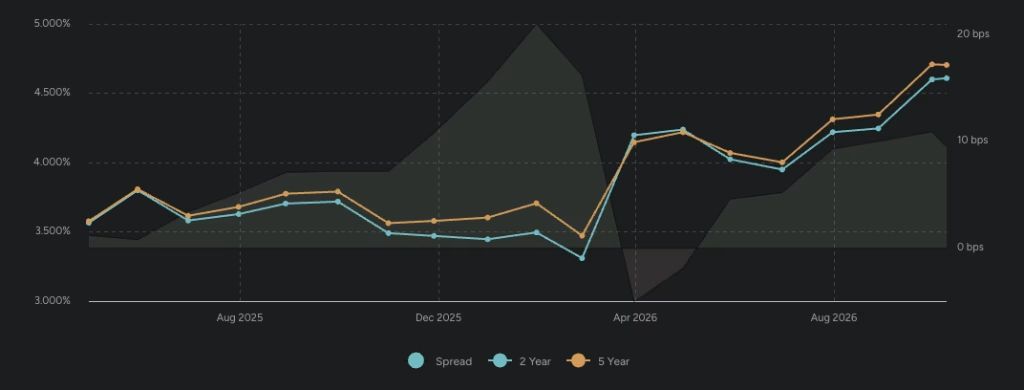
Two-year and five-year swap rates, monthly, over 18 months. Source: Chatham Financial, SONIA swap historical rates.
After dipping to roughly 3.3% (two-year) and 3.5% (five-year) around February 2026, both rose sharply in March and April and have continued upwards since. On 12 October 2026, the two-year swap rate stood at 4.593% and the five-year at 4.677%, according to the data used for this analysis. That is a rise of more than one percentage point in around seven months, and up from 4.247% and 4.347% on 28 August 2026, an increase of around a third of a percentage point in around six weeks. This upward movement in funding costs can be a key reason fixed mortgage rates have been increasing. However, mortgage pricing also depends on other factors, including lenders’ funding costs, competition and commercial decisions.
Geopolitical tensions have pushed up energy prices, adding to inflation concerns, and this is one of the reasons swap rates have risen recently. The UK Consumer Prices Index (CPI) inflation stands at 3.1%, above the Bank of England’s 2% target. The Bank held Bank Rate at 3.75% in September 2026, but the Bank has indicated a rise may be necessary if inflation persists. Uncertainty about the future path of interest rates is one factor influencing swap rates, although market pricing does not guarantee what the Bank’s next decision will be.
Markets may expect Bank Rate to rise, but the Bank of England appears to be taking a cautious view on raising rates too quickly. One reason is the jobs market. More people are looking for work and fewer jobs are available, and many employers are not taking on staff because they do not need to. That is keeping pay rises in check, and wage inflation is one of the key markers the Bank of England monitors.
From the Bank’s perspective, today’s inflationary pressures may be largely short term and geopolitical. While the initial impact of an energy price shock may be temporary, the Bank is also assessing whether higher costs could feed through into wider prices and wages, making inflation more persistent.
If energy prices fall, some of this upward pressure on inflation could ease. However, the outlook remains uncertain, and the extent to which these pressures persist will be an important consideration for the Bank of England when making future interest rate decisions.
With mortgage rates higher than earlier in the year, we would generally expect demand from buyers to soften, particularly for more expensive property. With fewer active buyers, in some cases, there may be more room to negotiate on the asking price.
If you agree a lower purchase price, you may need to borrow less. A smaller mortgage at a higher interest rate could have a similar monthly repayment as a larger mortgage at a lower rate. As a purely illustrative example, on a 25-year capital repayment mortgage:
| Loan amount | Interest rate | Monthly payment |
| £500,000 | 4.0% | £2,639 |
| £475,000 | 4.5% | £2,640 |
Illustrative figures only, assuming a constant rate for the full term and excluding fees. They are not a quote, and actual rates and payments will depend on your circumstances and lender criteria.
Over the longer term, if rates were to fall in the future and you remortgaged onto a lower interest rate, the smaller loan could result in lower costs overall. However, future interest rates are uncertain, and a lower rate cannot be guaranteed.
As an example, a homeowner looking to upsize might accept a lower price on the sale of their existing home, while negotiating a discount on the larger property they are buying. If the discount on the more expensive home is larger in cash terms, the overall cost of moving up may be lower than in a stronger market. Someone taking a long-term view, based on their own circumstances, may find this approach suits them. Property prices can fall as well as rise, and a quieter market does not guarantee that a buyer will secure a lower purchase price.
Put simply, in a quieter market there may be the potential to negotiate a lower purchase price, even if you need to reduce the sale price for the existing property. For someone stepping up the property ladder and buying for the long term, that could make this a good time to move.
If you are planning to sell, or want to keep your options open, it may be worth considering how different mortgage products can offer flexibility. Some tracker mortgages have no early repayment charge, which offers greater flexibility and could let you repay or move without a penalty. Tracker mortgage rates typically move in line with the Bank Rate, meaning your monthly repayments could rise or fall.
Tracker or fixed calculator
Check how tracker payments could change, against the certainty of a fixed rate.
For illustration only. Not a mortgage offer or advice.
Our latest sourcing comparison suggests that the difference between the lowest available fixed mortgage rates at 60% and 90% loan-to-value (LTV) was relatively modest on 8 October 2026.
For a £500,000 property purchase over a 25 year mortgage term, the lowest two-year fixed rate identified at 60% LTV was 4.92%, compared with 5.26% at 90% LTV, a difference of 0.34 percentage points. For five-year fixed rates, the difference was 0.32 percentage points, with rates of 4.93% and 5.25%, respectively.
Across the 44 lenders offering two-year fixed-rate products at both LTV levels on our sourcing system, the typical difference was less than 0.4 percentage points.
When interest rates rise, the gap between lower and higher LTV pricing tends to be squeezed. Trackers currently show a wider gap, at around 0.57 points (4.06% against 4.63%).
Rates shown are the lowest identified on our sourcing system on the date of the search. The illustration assumed a £500,000 purchase price and a 25 year mortgage term. Rates shown carry arrangement fees. Products, rates and eligibility criteria can change, and the rates available to an individual will depend on their circumstances and lender criteria.
There is a lot of focus on the headwinds, but there are also several potential deflationary pressures that could come into play over the next 12 to 24 months. If inflation eased, the Bank of England’s Monetary Policy Committee (MPC) may consider lowering Bank Rate, and swap rates could fall in anticipation.
Just as recent events pushed borrowing costs up, a change in the outlook could move them the other way within a relatively short time. None of this is certain, and rates could also stay higher for longer. But for buyers with a long-term view, it may be worth considering whether the current market offers an opportunity rather than a reason to wait.
If your fixed rate ends within the next six months: Some lenders may allow you to secure a new rate up to around six months before your current deal ends, although terms vary by lender. If rates continue to rise, having a rate agreed in advance may help protect you from further increases. If rates fall before your new deal starts, it may be possible to review the options again before completion, subject to the lender’s terms. Speaking to a broker now gives you time to compare options and consider alternatives to moving onto your lender’s standard variable rate (SVR), which is typically higher.
If you are on a tracker or variable rate: Your payments may change if Bank Rate or your lender’s variable rate changes, depending on the terms of your mortgage. Some tracker products have no early repayment charge, which may give you flexibility to switch, but check your terms first. A broker can help you weigh the certainty of a fixed rate against the flexibility of staying on a variable rate.
If you are moving home with an existing mortgage: You may also be able to take your existing mortgage with you to the new property (a process known as porting), subject to your lender’s criteria and approval. If approved, porting could avoid an early repayment charge. A broker can compare porting against taking out a new mortgage.
Rightmove’s latest House Price Index report also shows asking prices rose 0.7% in September, the first monthly rise since May, which Rightmove describes as a possible early sign of the usual autumn pickup in activity. If activity does increase, today’s conditions may not last indefinitely, so if you’re considering a move, it may be worth speaking to us to explore your options.
If you are thinking about buying, moving or remortgaging, our advisers can review your circumstances and help identify options that may be suitable for you. Private Finance compares over 300 lenders. Call us, email info@privatefinance.co.uk or use the enquiry form below.
This article is based on information available on the date of issue, 12th October, 2026.
The views and opinions expressed in this content are those of the author and do not constitute financial, legal, or professional advice, nor should they be interpreted as a recommendation. They do not necessarily reflect the official views, policies, or positions of Private Finance, and are not intended to represent broader market or industry perspectives.
Any figures, examples or market commentary are illustrative and based on information available at the time of writing, unless otherwise stated. They should not be taken as a prediction of future interest rates, mortgage costs or property prices. Past trends are not a reliable indicator of future market movements.
Sources:
YOUR HOME MAY BE REPOSSESSED IF YOU DO NOT KEEP UP REPAYMENTS ON YOUR MORTGAGE.
You may have to pay an early repayment charge to your existing lender if you remortgage.



Whatever your situation, our premier mortgage team can advise on suitable solutions. We specialise in complex and bespoke mortgage solutions to help you find competitive terms.
Residential Mortgages
Specialist Mortgages
Buy to Let Mortgages
Mortgages by Profession