











4.97 out of 5 based on 2,400+ reviews
Rated 4.97 out of 5 from 2,400+ reviews


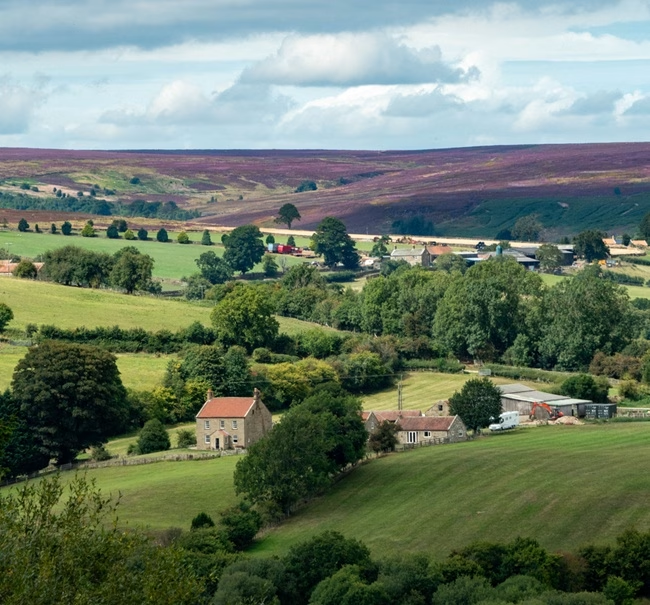
Rural homes often need specialist lenders due to acreage, annexes, listed status, Airbnb use, or non-standard construction. Legal quirks (unregistered land, overage, rights-of-way, agricultural ties) mean early broker support boosts approval and speeds the process.
Why mortgages differ
Few property purchases are as aspirational or complex as acquiring a country home or landed estate. Whether it is a Georgian manor set within rolling parkland, a converted farmhouse with equestrian facilities, a Scottish sporting estate, or a rural property with cottages and commercial outbuildings, the appeal is obvious. The path to ownership, however, is rarely straightforward.
Mainstream mortgage lenders are designed around standard residential properties in urban and suburban locations. When a property includes multiple acres of land, a mixture of residential and commercial uses, historic construction methods, or a web of historic legal rights and obligations, most high street banks will simply decline the application or offer far less than the purchase requires.
This does not mean the finance is unavailable. It means the most suitable lender, one with genuine experience in rural and estate lending, needs to be identified and approached correctly.
At Private Finance, this is precisely what we do. We work with private banks, specialist lenders, and family office funding sources who actively want to lend on high-value country properties, and who understand that the complexity of a rural estate is not a red flag but a natural feature of the asset class.
Common Country Property Mortgage Challenges
For a standard lender, a property with half an acre of garden is unremarkable. A property with fifty, five hundred, or five thousand acres is an entirely different proposition. Most mainstream lenders cap the land they will consider as part of their security at between two and five acres, anything beyond that, and the mortgage is declined or the excess land is excluded from the valuation.
For country house buyers, this is frequently a dealbreaker. Paddocks, home farms, woodland, and amenity land are not incidental features of a rural estate – they are integral to both the character and the value of the property. Specialist lenders understand this, will consider the full extent of the land within their security, and will instruct valuers experienced in assessing rural and agricultural holdings rather than standard residential comparables.
Where the estate includes a working farm or commercially let agricultural land, the position becomes more nuanced still. Some of the most competitive lending solutions in this space come from private banks and specialist rural lenders who take a holistic view of the asset – considering the land’s income-generating potential alongside its amenity value.
Many country houses come with estate cottages, gate lodges, or converted outbuildings that are occupied by staff, let to tenants, or used for holiday letting. From a mortgage perspective, these introduce complexity: the lender must consider the potential for third-party occupation to affect their ability to take possession in a default scenario, and the income from lettings may or may not be factored into the affordability assessment.
Experienced specialist lenders navigate this routinely. The key is presenting the property’s use accurately and comprehensively from the outset – including tenancy agreements, occupancy arrangements, and any relevant planning conditions – so that the lender can underwrite the full picture rather than discovering complications mid-application.
Equestrian properties – whether a modest yard with a few stables or a professional facility with an arena, ménage, and multiple paddocks, occupy an interesting position in the mortgage market. Some lenders will treat them purely as residential with land. Others will flag the commercial element if liveries are taken in or competition facilities are let out. A small number will decline entirely on the basis that the equestrian infrastructure reduces saleability.
The suitable approach is a lender who understands the market for equestrian properties and who can instruct a specialist equestrian valuer. These lenders exist, and they are often far more accommodating than general residential lenders, provided the application is structured correctly.
Country homes built before the mid-twentieth century were frequently constructed with materials and techniques that are entirely normal in the rural estate context but flagged as ‘non-standard’ by mainstream lenders. Timber frames, cob walls, thatched roofs, stone construction, and lime plaster all fall into this category. So do properties with partially modern extensions sitting alongside original historic fabric.
Specialist lenders, particularly those with experience in listed and heritage properties – understand that non-standard construction in a rural estate context is not a defect but a defining characteristic. What matters is the condition of the structure, the quality of any maintenance or restoration work, and the overall marketability of the property to buyers who seek this type of home. A specialist rural valuer’s report, rather than a standard RICS residential survey, is often a good starting point.
Listed buildings, whether Grade I, Grade II*, or Grade II in England; Category A or B in Scotland – carry legal obligations that affect how the property can be altered, extended, or repaired. For mortgage lenders, the concern is twofold: any unauthorised works carried out by previous owners may represent an unresolved liability, and the restrictions on future works may reduce the property’s appeal to a broad market.
In practice, listed status is not an obstacle to financing a country home – but it does require a lender who is comfortable with heritage property and a solicitor who will carry out thorough due diligence on consents and any outstanding enforcement issues. Most specialist lenders will want a structural survey from a surveyor with specific listed building experience, and they may ask for confirmation that any previous works were either consented or carried out in a manner that does not require consent.
Some rural properties, particularly former farm workers’ cottages and homes built under planning permissions granted for agricultural or equestrian purposes, are subject to occupancy conditions. These conditions restrict who can live in the property, typically to people employed in agriculture, forestry, or an associated rural industry.
Agricultural ties reduce the open market value of a property significantly, because they restrict the pool of eligible buyers. Most mainstream lenders will not touch them. However, specialist lenders who understand the rural property market may lend against a tied property where the borrower meets the occupancy criteria and the discount to open market value is reflected in the loan amount. In some cases, it may be possible to apply to the local planning authority to have the tie lifted or varied – a process that, if successful, can substantially improve both value and mortgage eligibility.
Overage clauses, provisions in a property’s title that entitle the seller (or a previous seller) to a share of any increase in value triggered by future development – are relatively common in rural and estate properties, particularly where land has been sold off from a larger holding. They can also arise where planning permission for additional dwellings has not yet been implemented.Overage clauses, provisions in a property’s title that entitle the seller (or a previous seller) to a share of any increase in value triggered by future development – are relatively common in rural and estate properties, particularly where land has been sold off from a larger holding. They can also arise where planning permission for additional dwellings has not yet been implemented.
Lenders dislike overage clauses because they represent a future financial obligation that may be triggered by events outside the borrower’s control, and because they complicate the lender’s ability to sell the property in a default scenario without triggering the overage payment. Specialist legal advice – and in some cases, negotiation with the overage beneficiary to limit or remove the clause, is often required before a lender will proceed.
Historic rights of way and public footpaths crossing a country estate are common and are generally not an obstacle to mortgaging, provided they are properly documented and the lender understands their scope. However, contested or poorly documented rights, private rights that benefit neighbouring landowners, or unusual easements over key parts of the property can raise concerns about saleability and enforceability.
Early review of the property’s title by a solicitor experienced in rural conveyancing is the best protection against late-stage surprises. Issues that are identified and resolved before exchange are rarely deal-breakers; the same issues discovered by the lender’s solicitor in the final week before completion can cause significant disruption.
A significant proportion of older rural estates, particularly in England and Wales, include parcels of land that have never been registered with HM Land Registry. Unregistered land is not unmortgageable, but it requires more extensive title investigation, often involving historical deeds going back decades or centuries. Indemnity insurance may be required to address specific title risks identified in that process.
Working with a solicitor who is comfortable with unregistered title, and a lender who will accept indemnity insurance in lieu of perfect title – is essential. This is not the place for a conveyancer with no rural experience.
high-net-worth lending
For buyers of significant estates and high-value rural properties, private banking relationships often offer advantages that specialist mortgage lenders cannot match. Private banks, including many with dedicated rural and estate lending desks can offer:
At Private Finance, we have established relationships with the private banking community and can introduce clients to lenders who are genuinely experienced in financing country estates and rural holdings at the higher end of the market. The most important step is an early, comprehensive conversation about your financial position and what you are looking to acquire.
The most common reason country property transactions encounter finance-related difficulties is not that the finance is unavailable – it is that the issue is identified too late. Buyers who have already agreed a price, instructed a solicitor, and set a completion date before speaking to a specialist broker find themselves with limited options and reduced negotiating power.
Our advice to anyone considering a country house or estate purchase is straightforward:
Why private finance
Private Finance is an independent, whole-of-market mortgage broker with direct access to private banks and specialist lenders often not available to borrowers directly. Our objective is to secure the most suitable funding structure for you and your estate.
For substantial country homes and landed estates, we start with an in-depth consultation to understand ownership, multi-title arrangements, and long-term aims, from refurbishment and conservation to succession planning and diversification. We then target lenders who understand rural assets and present your case clearly and compellingly.
Our consultants are experienced with complex scenarios including listed buildings, agricultural ties, mixed-use estates (residential, cottages, farmland, woodland, commercial), estate and investment income, trusts and corporate ownership, non-dom and offshore elements, and large loan sizes. We manage the process end-to-end, coordinating valuation, navigating legal nuances, negotiating terms, and handling the detail so you don’t have to.
Your home may be repossessed if you do not keep up repayments on your mortgage.
Whatever your situation, our premier mortgage team can advise on suitable solutions. We specialise in complex and bespoke mortgage solutions to help you find competitive terms.
Residential Mortgages
Specialist Mortgages
Buy to Let Mortgages
Mortgages by Profession