Being asset rich and cash poor can be a familiar position for high net worth clients who have spent years building wealth into property, pensions and investments. However, it can become a problem the moment an institution requires evidence of funds that are immediately accessible.
This is a situation a couple in their sixties found themselves in. Here’s how they took out a mortgage to raise cash they needed against a house they owned outright, without needing to sell investments at the time.
At a glance
| Client profile | High net worth, asset rich, low earned income |
|---|
| Property value | £2.4 million, owned outright |
|---|
| Investments retained | £1.9 million in ISAs and pensions |
|---|
| Loan amount | £300,000 |
|---|
| Loan to value (LTV) | 12.5% |
|---|
| Product | Two-year discount variable, interest only, 12-year term |
|---|
| Lender type | Building society |
|---|
Your home may be repossessed if you do not keep up repayments on your mortgage.
The clients' situation
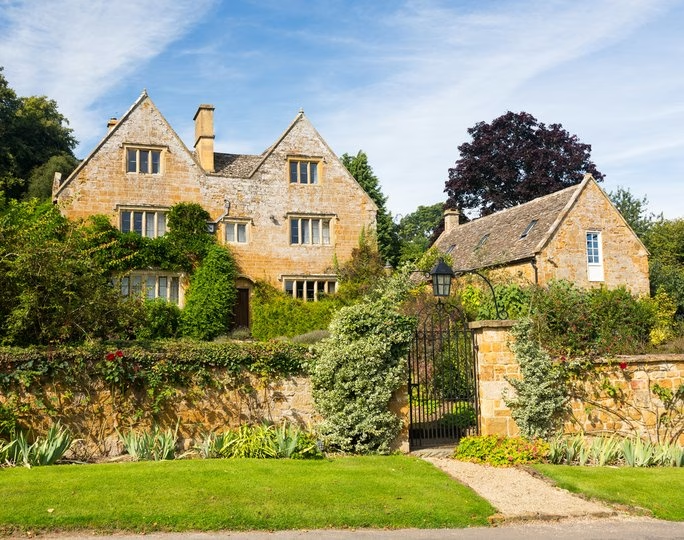
A couple, both in their sixties, were living in a Grade II listed period house with an annexe, valued at £2.4 million, which had no mortgage at the time. Between them they held £1.9 million across Individual Savings Accounts (ISAs) and pensions.
One is self-employed, with a small salaried role alongside a business they had run for many years. The other is retired and derives their income from restricted stock unit (RSU) distributions.
Their child had a place at a university overseas. The parents had decided to fund the course directly rather than have their child take on significant student debt. However, the student visa process required proof that the first year’s fees could be met and it would accept only immediately available cash, in a bank statement less than four months old.
The challenges
The main challenges included:
- Low earned income on paper. An asset rich, cash poor household can face difficulties meeting a requirement for immediately accessible funds, even when those funds represent only a small proportion of their overall wealth. Traditional affordability assessments typically focus on regular income, while undrawn pensions and investments may not be fully reflected in standard affordability calculations.
- The structures built for this position did not fit. The clients’ first preference was an offset mortgage. Whilst the clients hold substantial ISA, pension and investment assets, the majority of offset lenders were unable to satisfactorily accommodate affordability based solely on the earned income and would not consider the background assets unless they were already being actively drawn upon. This did not fit the clients’ preference to preserve their investment positions and avoid unnecessary encashment of pension or ISA funds.
- The property narrowed the lender choice further. Grade II listing, a converted outbuilding classed as ancillary accommodation, and land. Each of those on its own shortens a lender list. Add a 12-year term for borrowers in their sixties, running past state pension age and most of the market falls away on criteria rather than on risk. Additionally, owning a home outright can make borrowing harder rather than easier, because so many flexible products are designed to sit behind an existing mortgage.
These characteristics reduced the number of lenders whose published or underwriting criteria appeared capable of accommodating the case.
How we approached it
Some specialist lenders may consider lending to high net worth clients whose wealth doesn’t arrive as income, and can assess the two together.
The specialist lender was able to consider the pension assets and investment holdings within affordability assessments, including assets that were not currently being drawn as income. The lender applied its own methodology to assess the potential income that could be generated from these assets over the mortgage term. This enabled the £300,000 borrowing requirement to be considered within the lender’s affordability criteria.
Key criteria that were relevant to the lender’s assessment included:
- No maximum age at the end of the term
- Income accepted to age 75
- Undrawn assets admissible
- Acceptance of downsizing and future sale of the property as an acceptable repayment vehicle
- Ability to lend on a listed property with an annexe
The clients expect to downsize within two to three years and repay from the sale proceeds. We recommended a 12-year term to provide greater flexibility if the planned move takes longer than anticipated, reducing the need to refinance in their mid-sixties.
The outcome
£300,000 was raised against the house over a 12-year term, at 12.5% loan to value. The mortgage is on an interest-only basis, which means the £300,000 capital will remain outstanding throughout the mortgage term and must be repaid at the end of the term. In this case, the proposed repayment strategy is to sell the property and use the sale proceeds to repay the mortgage, with the clients intending to downsize to a smaller property.
The clients considered that retaining their investments was preferable to selling them at that time. This was their preference based on their individual circumstances and longer-term financial plans.
Speak to an adviser
If you hold significant assets but limited earned income and need to raise capital, we can talk through what mortgage solution may be available. Call us or use the enquiry form below.